
Resource Center
Welcome to the Rotajet Resource Centre where you can find everything about industry standards when it comes to container washing: from how to clean an IBC to requirements for safe transportation. If you have any further questions, or would like to know more about how our solutions can help your business, please get in touch.
How to Clean an IBC
It is important that businesses using them know how to clean an IBC to industry standards in order to avoid cross-contamination; especially when it comes to hazardous chemicals. The materials that are stored in IBC’s are wide and varied; from dairy products and fruit juices, to dangerous and hazardous chemicals. For this reason, any IBC which has previously been used should have a label that details the last product which the IBC has contained. This label will detail the name of the previous chemical and also the hazards associated with the chemical. If the IBC has previously contained a hazardous chemical, the IBC will be classed as hazardous packaging under WM3 packaging regulations.
Many IBC’s are cleaned to avoid cross-contamination from one product to another prior to refilling, or periodically cleaned to allow for periodic testing and inspection. As well as this, it is also important to clean an IBC which can no longer be used, prior to safe disposal. Rotajet manufacture a range of IBC and drum shredding and washing equipment, information regarding this machinery can be found here.
In order to reuse a commercial IBC, it is vital that a full and professional clean is conducted to prevent any cross-contamination or future users coming into contact with unknown hazardous materials. This process should be undertaken by a competent individual with the relevant knowledge, experience, and equipment to carry out the task.
Using an omnidirectional spray head ensures complete coverage of the internal surfaces of the IBC. Depending on the level and type of the contamination, different cleaning mediums may be used to clean an IBC, including; caustic, detergents, and, if the equipment is compliant with the ATEX directive, solvents.
IBC reconditioners are required by environmental and company law to ensure friendly disposal of hazardous waste as well the implementation of a safe cleaning practice. An ECD (European Cleaning Document) must be produced to show that the IBC has been professionally cleaned and is safe from hazardous materials.


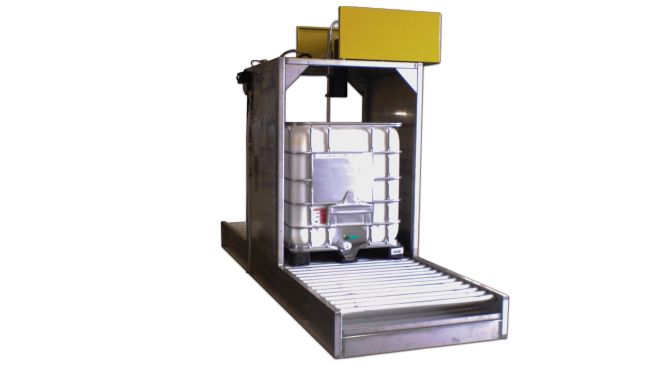
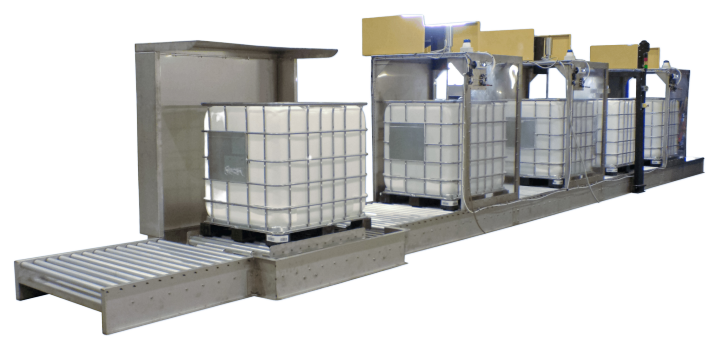
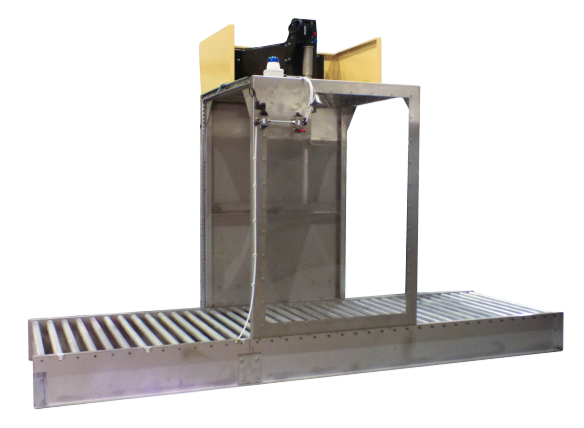
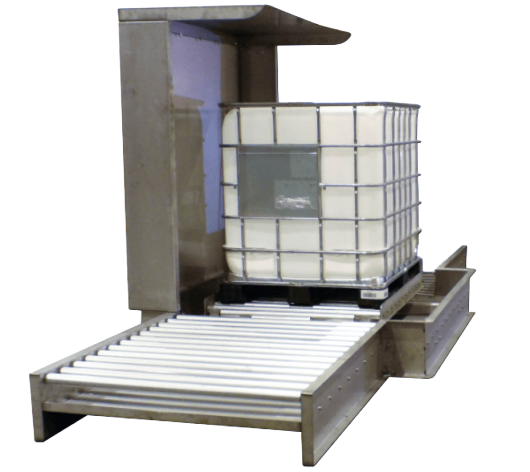
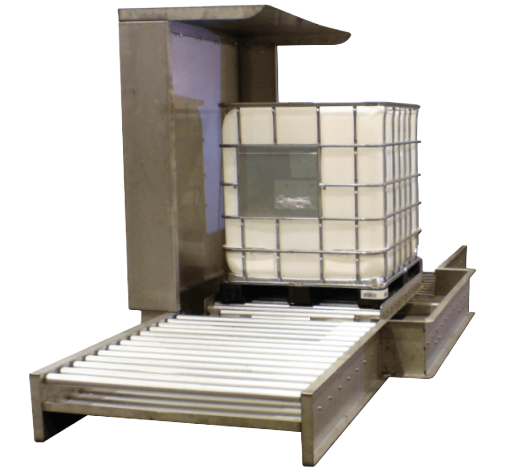


Fig.1 | RJ-IW-Auto: IBC Reconditioning System
IBC Pressure Testing Specification
Pressure testing an IBC is a vital step in the reconditioning process as it is used to ensure the vessel is structurally sound enough to hold the liquid without leakages. As an IBC reconditioning company, this process can make or break an operation. Leakages and clean-up operations represent significant losses in profit, as well as presenting a serious health and safety risk. To prevent such issues occurring, regulations have been drawn up to create an international standard that must be met prior to an IBC entering the transportation network.
The UNECE requirements for the construction and testing of intermediate bulk containers (IBCs) state that “IBCs, their attachments, and their service and structural equipment shall be designed to withstand, without loss of contents, the internal pressure of the contents and the stresses of normal handling and carriage. IBCs intended for stacking shall be designed for stacking. Any lifting or securing features of IBCs shall be of sufficient strength to withstand the normal conditions of handling and carriage without gross distortion or failure and shall be so positioned that no undue stress is caused in any part of the IBC.”
To ensure every IBC meets this requirement, one of the following specifications must be met:
- 1.75 times the vapour pressure at 50 °C of the substance to be carried minus 100 kPa, but with a minimum test pressure of 100 kPa;
- 1.5 times the vapour pressure at 55 °C of the substance to be carried minus
100 kPa, but with a minimum test pressure of 100 kPa; - Twice the static pressure of the substance to be carried, with a minimum of twice the static pressure of water.
Rotajet have designed a pressure tester that can either be integrated within a full reconditioning system or used as a standalone machine. The RJ-IPT pressure tester measures composite IBCs to ensure these characteristics are present; allowing our customers to rapidly fulfill these requirements for every IBC prior to carriage.
IBC Transportation
IBCs are incredibly useful for storing and transporting chemicals, but they can be challenging to clean. Each IBC must be thoroughly cleaned and reconditioned before they can be reused even in their own procedures.
To ensure the IBC is suitable for transport, it must be UN/DOT tested to ensure it is sound, leak proof and meets the correct pressure rating. Our RJ-IW-Auto IBC reconditioning line automates this process for our customer and ensures each IBC is ready to meet the demands placed on it during transport.
If the IBC label states the previous contents of the IBC were hazardous, the IBC must be transported by a company with an ADR license to a site that is approved by the Environment Agency.
IBC Manufacturers
Greif, established in 1877 is one of the oldest manufacturers on the planet and first brought IBC lines to the market in 1990s. Today their wide-ranging products have a presence in 40 major markets. Their popular designs range from the basic GCUBE through to application-specific models such as the GCUBE Elektron, which is static-proof for the storage of flammable substances.
Schutz originated in Germany in 1958 and focuses on environmentally sustainable container production. Shutz has standard designs for IBCs sued in chemical manufacturing, petrochemicals, food productions, agriculture, and electronic manufacturing. For heavier or more volatile substances, Schutz manufactures IBCs in a range of sizes from 640L to 1250L with the standard being 1000L.
Mauser has remained a leading industrial packing manufacturer since it found success fabricating steel drums in 1902, and now has more than 100 offices around the globe. Alongside standard products, Mauser also boasts a full range of specialist models, as well as a comprehensive repair, refurbish, and recycling scheme.
Werit is also a key manufacturer of IBCs with a worldwide presence. With a huge range of models suitable for specific industry applications. The added features available include; reinforcement, anti-static and flame-retardant coatings, CDS withdrawal systems and even food-grade containers; even meeting Kosher and Halal food standards.
Schoeller Allibert is a European-based IBC manufacturer that was established in 1959, and has some representation in other markets across the globe. Despite a slightly smaller reach than other IBC manufacturers, they boast some of the most ingenious IBCs on the market and are well known for their specialty IBCs. One notable example is the Combo Fructus: a hard plastic tank that is foldable, making it easy to store and clean. Like its competitors, Schoeller Allibert offers repair and refurbishment of their tanks in order to reduce their environmental impact.
IBC Trade Associations
IPA member companies can assure their customers that they meet the highest quality of testing, quality control, environmental care and life cycle services. This shows that the packaging purchases can cope with the most demanding industrial applications. The IPA was initiated in 2004 from merging The Association of Drum Manufacturers (ADM), The Rigid Intermediate Bulk Container Association (RIBCA) and members of the Federation of Drum Reconditioners (FCDR).
The ICCR is open to any container reconditioner or association representing reconditioners. This association concentrates on providing an international consortium for key issues in regulation, and represents the industry to bodies such as the UN, International Maritime Organisation, and the International Civil Aviation Organisation.
The NACD is a body committed to; creating better connections between manufacturers and users, and the distribution of high-quality packaging components, such as IBCs. They aim to advocate that the most effective and efficient channels is the wholesale distribution of packaging components to manufacturers of industrial and consumer packaging. They provide networking opportunities for their members to form strong and long lasting business relationships.